Wales

MaresConnect strongly believes that a proactive and constructive dialogue with local Welsh stakeholders throughout the development programme will result in the highest quality application and project design.

Community - Wales - MaresConnect

MaresConnect in Wales

MaresConnect Wales Public Consultations - September 2026We will be holding further community consultations in September 2026 to better understand local concerns and to provide up-to-date information on the project. As the project progresses, we will establish an online portal for local business to connect with the MaresConnect procurement process.

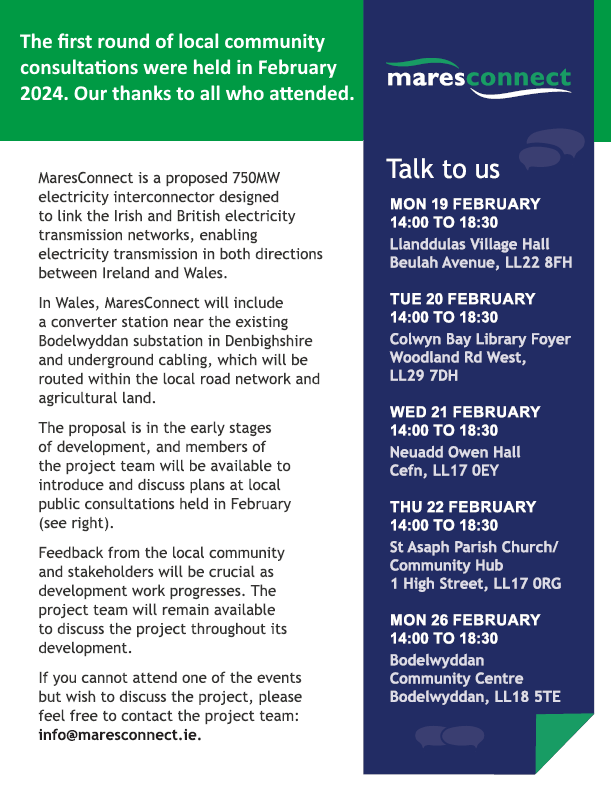
In Wales, MaresConnect will consist of a converter station sited near the existing Bodelwyddan substation in Denbighshire and underground cabling, which will be routed within the local road network and agricultural land.

Various detailed technical and environmental surveys will be carried out during the development process to ensure that the final design fully incorporates the challenges and opportunities of the local environment.

Technical and environmental studies will include:

  • Biodiversity;
  • Historic environment;
  • Landscape and visual impact;
  • Flooding and hydrology;
  • Geology and hydrogeology;
  • Noise and vibration;
  • Traffic and transport;
  • Socio-economic impact and human health; and
  • Air quality and climate change

Construction of the MaresConnect Interconnector is expected to lead to significant capital investment in Wales.  We are committed to maximising the use of locally based contractors and personnel during the construction and operational phases of the project and are always keen to hear of local businesses that could benefit.

Current Status

Landfall location

This is the location where the subsea cable reaches the shore and is connected to the onshore cable. The method of installation selected will depend on the results of consultation and technical and environmental surveys. The selected method will be clearly described in planning documentation to ensure that the local community and permitting authority is fully informed on the proposed methodology to be used when reviewing the application documentation.

Current status: A desk based feasibility study, reviewing known environmental and technical constraints, identified three potential landfall and converter station zones. The potential options were discussed during public consultation events held in February 2024 and were subject to further assessment.

Following the completion of subsea surveys, stakeholder consultation and onshore technical and environmental assessment MCL has identified a preferred landfall location.

Underground HVDC cables

The onshore cable route between the landfall location and converter station will consist of buried High-Voltage Direct Current (HVDC) cables. Typically, HVDC cables can be installed within the local road network and the initial default onshore route is likely to be located predominantly within the road network prior to refining the proposed cable route as consultation and environmental and technical assessments are undertaken. We are aiming to identify the shortest cable route that can be installed in an environmentally sensitive manner while minimising impacts on the local community.

Current status: MCL’s preference is to install cables between the landfall and the sea using a trenchless installation methodology such as a Horizontal Directional Drill (HDD) or Direct Pipe (DP). At this location, it is believed that a trenchless method of installation will minimise impacts on recreational users and nearshore habitats along the Welsh coast. Further technical assessment work will be undertaken before the installation methodology is finalised with the adoption of an HDD or Direct Pipe method anticipated.

Potential onshore cable routes have been identified. HVDC cables can be installed in a trench less than a metre wide so are suited to being installed within local road networks. Two of the current cable options are located within the road network while the other crosses agricultural and recreational land. Final design and cable route selection will be subject to stakeholder consultation and the completion of appropriate environmental and technical assessments.

Converter station

A converter station will be located close to the existing Bodelwydden National Grid substation. The final proposed location and design will depend on the results of consultation and environmental and technical assessments.

Current status: Following the public consultations, further assessment and consultation a preferred converter station zone has been identified containing three potential converter station sites. The final preferred converter station site will be selected following public consultations to be held in September 2026 and a thorough assessment of the technical and environmental constraints facing each option.

Underground HVAC cables

High-Voltage Alternating Current (HVAC) cables are required to connect the converter station to the exiting National Grid substation. The cables are expected to be buried for the full length of the cable route between the converter station and substation.

Current status: Preferred HVAC cable route assessment ongoing and will be consulted on.

MaresConnect Interconnector
Privacy Overview

This website uses cookies so that we can provide you with the best user experience possible. Cookie information is stored in your browser and performs functions such as recognising you when you return to our website and helping our team to understand which sections of the website you find most interesting and useful.